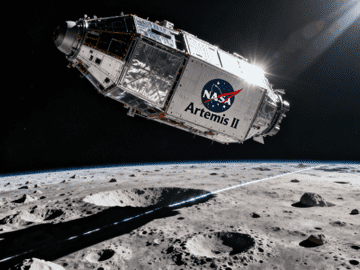

The successful conclusion of the NASA Artemis II mission officially signals a new era for humanity, as the Orion spacecraft proves we are ready to reach further into the stars than ever before. This journey represents a monumental Moon exploration milestone, serving as the first time a crew has visited the lunar neighborhood in over five decades. By navigating the deep space environment with precision, the mission has demonstrated that both our technology and our strategic vision are prepared for the challenges of the next frontier. While industry observers have long discussed the potential of returning to the lunar surface, this unified effort confirms that the Moon is no longer just a light in the sky, but a destination once again within our reach.
This moment reflects a strategic shift where high-performance engineering serves as the primary engine for the expansion of the Deep Space Exploration Market and domestic industrial innovation. In this blog, we uncover the technical leap toward a robust lunar economy and the emergence of next-generation infrastructure for a world defined by sustainable space travel. But the real question is, what does the success of NASA Artemis II signal for the future of the global space hierarchy?
First crewed Moon orbit mission in decades
The success of the NASA Artemis II mission serves as a powerful statement of American capability and strategic vision in the modern era. We are seeing an incredible expansion of the Deep Space Exploration Market as U.S. companies and government agencies collaborate to build a sustainable presence beyond Earth's orbit. This trend highlights a shift toward a robust lunar economy, where private innovation and public goals align to drive long-term investment in space exploration advancement.
NASA’s Artemis II returns safely after historic Moon mission
The astronaut crew mission officially ended after a ten-day journey that saw the spacecraft named Integrity push the boundaries of crewed spaceflight. The NASA Artemis II team, consisting of three Americans and one Canadian, remained in excellent health throughout the duration of the flight. This space agency mission was designed to test the vital systems that will eventually carry humans back to the lunar surface for longer stays. From the moment of liftoff to the final moments of the descent, every system performed with remarkable precision. This journey was more than just a flight; it was a rigorous evaluation of the Artemis program hardware under the most unforgiving conditions. The successful return of the crew is a testament to years of preparation and the tireless work of thousands of experts across the country.
Orion spacecraft completes perfect Pacific Ocean splashdown off San Diego
One of the most critical phases of any NASA Moon mission 2026 is the re-entry and landing, and the NASA Artemis II splashdown was described as nothing short of perfect. The Orion spacecraft splashdown Pacific Ocean occurred near San Diego, where recovery teams were waiting to assist the returning heroes. This Pacific Ocean landing marked the end of a high-speed journey through the Earth's atmosphere, where the spacecraft had to withstand extreme temperatures. The successful space mission splashdown San Diego proves that the Orion heat shield and parachute systems are fully capable of protecting crews returning from the deep space environment. Seeing the capsule bobbing safely in the water was a sight of pure relief and triumph for everyone involved. It was the final, essential step in a mission that has set a new standard for human spaceflight return.
Four-astronaut crew highlights international collaboration in deep space flight
The Artemis II astronauts landing back on Earth were Commander Reid Wiseman, pilot Victor Glover, and mission specialists Christina Koch and Jeremy Hansen. This astronaut crew mission was notable for its diversity and the inclusion of a Canadian specialist, highlighting the global nature of modern lunar orbit mission planning. By working together, these "ambassadors to the stars" showed that deep space exploration is a shared human endeavor that transcends national borders. Each member of the crew brought unique expertise to the mission, ensuring that every objective was met with the highest level of skill. Their teamwork is a model for future missions where international partnerships will be the backbone of our efforts to live and work in space.
Mission marks farthest human travel from Earth in over 50 years
The NASA Artemis II flight was truly a journey into the record books, as the crew reached a distance of 252,760 miles from our planet. This represents the farthest any human has traveled since the post-Apollo lunar mission era ended decades ago. By venturing so far, the Orion spacecraft mission provided vital data on how the human body and spacecraft systems react to being away from the protective magnetic field of Earth. This deep space mission splashdown concludes a chapter where we have finally stepped out of low-Earth orbit and back into the deep void. It is a staggering achievement that reminds us of the scale of our solar system and our potential to explore it.
Lunar orbit mission captures new craters and rare solar eclipse views
During their time in the lunar orbit mission, the crew had a front-row seat to sights that few have ever seen. They were able to capture high-resolution photos of never-before-seen parts of the lunar surface, identifying several new craters in the process. In a touching gesture, the crew even named a newly discovered crater after Commander Wiseman’s late wife, Carroll. The Artemis II Moon mission landing preparation also allowed the crew to witness a total solar eclipse from a perspective that no human has experienced before. These Artemis II mission highlights provide scientists with a wealth of new information to study as they plan future landings. These visual records are not just scientifically valuable; they serve as a beautiful reminder of the wonders that await us in the lunar wilderness.
NASA leadership calls mission a key milestone for future deep space exploration
The NASA Artemis program update 2026 from leadership has been overwhelmingly positive, with officials calling the mission a "perfect" success. NASA Administrator Jared Isaacman noted that America is firmly back in the business of sending humans to the Moon and bringing them home safely. This space mission success has lowered the risk for future flights by proving that the Space Launch System and Orion craft are ready for the next level of intensity. Leadership emphasized that while this was a test mission, it was a necessary bridge to the more complex operations that will follow. The Artemis II mission results give the agency the confidence to move forward with plans for long-term lunar residence. It is a clear signal that the era of "flags and footprints" has evolved into an era of permanent presence.
What Artemis II means for future Moon bases and next-generation missions
The Artemis II crew return Earth safely is the green light that the world has been waiting for to begin building on the lunar surface. The data gathered during this Moon orbit mission NASA crew will be used to design the first permanent Moon base and the logistics systems needed to support it. We are now looking at a future where the Moon serves as a stepping stone for even more ambitious journeys, such as crewed missions to Mars. Next-generation missions will build on the lessons learned during this NASA lunar orbit mission success to create sustainable habitats and refueling stations in space. The success of NASA Artemis II means that the dream of seeing humans living and working on another world is no longer a distant fantasy, but a scheduled reality.