
A profound transformation is unfolding within the landscape of commercial risk management. As the domestic economy experiences a surge in high-value physical assets, from semiconductor manufacturing facilities to large-scale power generation sites, the traditional methods of manual underwriting are being dismantled. A significant infusion of capital into the AI insurance ecosystem has signaled a move toward a digital era where the velocity of insurance provision must match the rapid pace of modern industrial expansion. This development suggests a broader trend toward the institutionalization of automated risk protocols, where software-driven precision replaces fragmented, legacy data systems. In this blog, we will discuss the technical foundations of autonomous underwriting and the shift toward behavior-based risk evaluation. What does Shepherd’s deal mean for AI insurance growth?
How Shepherd Reflects Broader U.S. Insurtech and AI Infrastructure Trends
The United States continues to lead in digital transformation across the insurance sector, driven by rising demand for automation and faster decision-making. The Shepherd AI insurance platform funding aligns closely with these U.S. insurtech market trends, where enterprises expect instant quotes and transparent pricing. Companies managing large-scale infrastructure projects increasingly rely on AI-powered risk analysis platforms that can process complex datasets quickly.
At the same time, the expansion of the AI infrastructure insurance market reflects a growing need to insure high-value, high-speed developments such as data centers and energy facilities. Insurers are moving toward digital underwriting transformation, replacing outdated workflows with intelligent systems that respond in real time. Shepherd’s model fits directly into this environment, offering a modern approach that supports both scale and accuracy.
How Shepherd Is Transforming Commercial Insurance With AI
Shepherd is redefining how commercial insurance operates by replacing manual workflows with a fully automated, AI-driven system. Traditional underwriting often involves delays, fragmented data, and repeated back-and-forth communication. Shepherd’s platform removes these inefficiencies by integrating real-time data and automation into every step of the process.
- An artificial intelligence-based underwriting insurance platform provides insurance quotes within minutes.
- The platform utilizes real-time construction data to support dynamic risk assessment.
- It integrates with construction and mobility infrastructure software to enhance data interoperability.
- Continuous data flow enables the maintenance of accurate and up-to-date risk profiles.
This approach allows insurers to move faster while improving accuracy. It also reflects a broader shift toward commercial insurance automation AI, where decisions are based on live data rather than static reports.
What Shepherd’s $42M Series B Funding Means for AI Infrastructure Growth
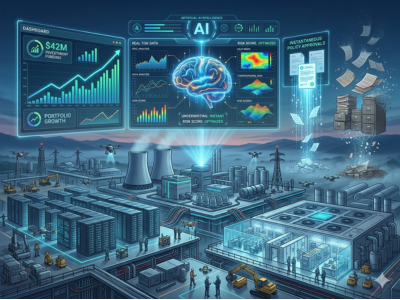
The Shepherd Series B funding 2026 round highlights strong investor confidence in AI-driven insurance models. With total funding reaching $67 million, the company is scaling its operations to meet rising demand from infrastructure sectors. Shepherd has already issued over 1,500 policies and covered projects valued at more than $400 billion, showing rapid growth in a short time.
This funding supports expansion into key areas such as data center insurance solutions and energy infrastructure coverage. As investment in AI-driven facilities continues to rise, Shepherd’s ability to provide fast and reliable insurance becomes critical. The company is positioning itself as a core enabler of infrastructure growth, where traditional insurance systems struggle to keep pace with demand and complexity.
How AI Underwriting Reduces Insurance Processing Time From Weeks to Hours
One of Shepherd’s most significant contributions lies in reducing underwriting time from weeks to hours. Its platform uses autonomous underwriting technology to process data instantly, eliminating delays that have long defined the industry. By analyzing real-time inputs, the system generates accurate risk assessments without requiring prolonged manual review.
This shift improves efficiency for brokers, developers, and insurers alike. It also enhances decision-making by providing up-to-date insights rather than relying on outdated information. As construction timelines shorten and infrastructure projects accelerate, such speed becomes essential. Shepherd’s model demonstrates how AI-powered systems can transform insurance into a faster and more responsive service.
Why Data-Driven Risk Pricing Is Disrupting Traditional Insurance Models
Shepherd’s platform introduces a new approach to pricing, moving away from generalized risk categories toward precise, data-driven evaluation. By integrating with tools that capture real-time project data, the system creates a detailed understanding of each project’s risk profile. This enables behavior-based insurance pricing that reflects actual performance rather than assumptions.
- Continuous data input from construction and monitoring systems
- Smart risk pricing models based on real-time activity
- Improved accuracy in premium calculation
- Alignment of pricing with operational performance
This model challenges traditional insurance practices and supports a more transparent and fair system. It also highlights the growing role of AI in reshaping how risk is measured and priced.
How Behavior-Based Pricing Is Reshaping Commercial Insurance
Behavior-based pricing represents a fundamental shift in how insurers evaluate risk. Shepherd uses real-time data to reward safer practices, encouraging companies to adopt better technologies and processes. This approach mirrors telematics commercial insurance models, where behavior directly influences cost.
By connecting prices to how well things perform, Shepherd encourages better safety and efficiency. This helps clients and lowers the overall risk for insurers. The model is part of a larger trend toward smart pricing methods that use data instead of guessing. As more companies adopt this approach, it is likely to become a standard across the commercial insurance landscape.
Future Projections for the AI-Powered Insurance Sector
- The ongoing expansion of the AI infrastructure insurance is expected to require specialized coverage for semiconductor manufacturing facilities and advanced energy initiatives.
- Projected growth in the U.S. insurtech market indicates that competition between AI-driven insurance carriers and traditional providers will increasingly center on data transparency.
- Advancements in intelligent risk pricing models are anticipated to result in more personalized policy structures for large-scale industrial contractors.
- The application of telematics-based commercial insurance principles within heavy industry is expected to yield deeper insights into long-term
- Recent trends in insurtech startup funding demonstrate sustained interest in platforms that connect software engineering with actuarial science.ng and actuarial science.
How Shepherd Is Powering Insurance for Data Centers and Energy Projects
The rapid growth of AI infrastructure has created new demands for specialized insurance solutions. Shepherd addresses this need by focusing on sectors such as data centers, energy projects, and semiconductor facilities. These projects require fast, accurate coverage that can adapt to changing conditions.
Shepherd’s platform provides insurance for data centers and energy projects with a level of precision that traditional carriers often lack. By using real-time data and AI analytics, it ensures that coverage remains aligned with project realities. This capability positions the company as a key player in supporting the infrastructure that powers the digital economy.
Long-Term Outlook of the Industry
As the Shepherd AI insurance platform funding continues to influence the sector, the long-term outlook for commercial insurance remains focused on total automation and data integration. The ability to provide insurance for data centers and energy projects at scale is no longer an optional capability but a necessity for the modern economy. We are witnessing a fundamental change in how project value is protected, shifting from reactive claims management to proactive, data-driven risk mitigation.
This evolution suggests that the most successful participants in the 21st-century insurance market will be those who can effectively synthesize vast quantities of site-level data into actionable financial insights. Ultimately, the success of these AI-native platforms will be measured by their ability to provide the financial foundation for the next generation of global infrastructure.