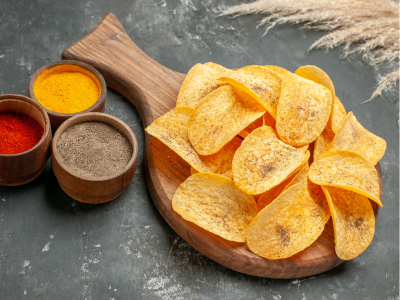

We all recognize that first bite. The brittle snap. The savory bloom. The fleeting hush that follows a perfect crunch. Snack lovers worldwide know this moment well. Engineers and food scientists obsess over it. Marketers try to bottle it. Yet the potato chip crunch is not magic. It is physics and chemistry, with a dash of clever design.
In this blog, we break down the science behind crispness. We also explore how factories engineer that signature sound. Moreover, we decode how oil and moisture dance inside thin potato sheets. Finally, we share what keeps chips crunchy across oceans and climates.
What “Crisp” Really Means
Crispness is a multi-sensory experience. It depends on texture, sound, and rapid fracture. When your teeth meet a chip, its microstructure fails in tiny cascades. Each crack emits sound waves you hear as a crunch. Meanwhile, your tongue perceives a brittle, dry texture. Together, they create potato chip crunch. Importantly, crispness is not simply hardness. A stale cracker can feel hard but not crisp. Crisp foods fracture easily into clean shards. They offer minimal resistance. They break rather than bend. Therefore, crispness demands low moisture, rigid structure, and controlled thickness.
The Potato: Starting Materials Matter
Not all potatoes deliver equal performance. Varieties with higher dry matter produce better chips. They brown evenly and absorb less oil. Conversely, high-sugar potatoes burn quickly and taste bitter. Thus, farmers manage storage temperatures to control sugar levels.
Additionally, cell structure affects texture. Potatoes with firm, uniform cells create a stable, brittle matrix when fried. That matrix becomes the backbone of potato chip crunch.
Slicing and Geometry: Thin Wins, but With Limits
Chip thickness dictates fracture behavior. Ultra-thin chips shatter quickly and feel delicate. Slightly thicker chips offer a deeper crunch. However, too thick, the bite becomes heavy. Shape also matters. Flat chips present consistent fracture planes—meanwhile, ridged chips channel stress into multiple cracks. Therefore, ridges can amplify acoustic excitement. Cutting smooth, consistent slices reduces defects. Consequently, manufacturers use sharp, high-speed blades. They also manage surface roughness to guide oil behavior during frying. Subtle edges can improve potato chip crunch without extra oil.
Starch Gelatinization: The Crunchy Transition
As slices hit hot oil, heat moves inward. Water turns to steam. Pressure builds and escapes through microscopic pores. Meanwhile, starch granules swell and gelatinize. This step sets the chip’s internal scaffold. Then, as moisture leaves, the structure dries and rigidifies—a glassy, brittle network forms at the surface. If well-controlled, the result is a clean, audible snap. That structure must survive cooling, transport, and humidity swings. When it does, you get a reliable potato chip crunch.
Maillard Browning: Color, Flavor, and Perception
The golden hue signals more than beauty. The Maillard reaction builds flavor and aroma. It also stiffens the surface and influences fracture properties. However, browning must be controlled. Excess heat can cause bitterness or uneven texture. Balanced browning supports the perceived intensity of potato chip crunch.
Oil Absorption Dynamics: A Love–Hate Relationship
Oil is not just a cooking medium. It becomes part of the chip. During frying, steam pushes oil away. Then, after removal, the pressure inside the chip drops. Consequently, oil gets pulled into surface pores. This post-fry uptake determines greasiness, flavor delivery, and shelf life. Engineers reduce absorption by controlling moisture gradients. They also tune surface roughness and exit temperatures. Moreover, they may use pre-drying, blanching, or vacuum frying. These methods help optimize the final potato chip crunch while keeping oil levels in check.
The Physics of Drying: Moisture, Water Activity, and Fragility
Low moisture is crucial. But water activity (a_w) tells the real story. It measures how tightly water binds within the food matrix. Chips target a narrow a_w range. Too high, and the surface softens. Too low, and the chip may become brittle and prone to breakage. Therefore, manufacturers measure a_w throughout production. They fine-tune fry time and temperature. Additionally, they manage cooling curves to avoid condensation. Stable a_w secures long-lasting potato chip crunch.
Crunch Acoustics: Why Your Ears Judge Freshness
Sound completes the experience. When your teeth fracture a chip, it releases bursts of acoustic energy. Micro-cracks produce short, high-frequency peaks. Your brain reads these signals as crispness. Interestingly, people can detect stealing by sound alone. Consequently, researchers measure crunch using microphones. They analyze amplitude, frequency, and temporal patterns. A clean, bright acoustic profile matches a strong potato chip crunch. Brands know this—some even test chips in acoustic rigs to standardize the sound.
Texture Engineering: Kettle vs. Continuous vs. Vacuum Frying
Kettle-cooked chips are fried in small batches. They cook at slightly lower temperatures and for longer times. This method yields robust, craggy surfaces and a heartier crunch. Continuous frying uses conveyors for high throughput. It controls temperature and time precisely. Consequently, it produces uniform texture, color, and potato chip crunch at scale. Vacuum frying lowers the boiling point of water. Thus, it enables frying at lower temperatures. It preserves color and natural flavors. It also reduces oil degradation. The result can be a cleaner taste and crispness with gentler processing. This method suits delicate varieties and global markets with heat-sensitive flavors.
Oil Choices: Stability, Flavor, and Mouthfeel
Oil type influences both nutrition and texture. High-oleic oils resist oxidation and rancidity. They also deliver neutral flavor and stable crispness. Palm olein offers excellent frying stability, but faces sustainability scrutiny. Sunflowers and canola are common in many regions.
Meanwhile, blends help balance cost, health perception, and potato chip crunch. Some innovators explore structured oils and oleogels. These materials can control oil mobility after frying. Consequently, they may reduce greasiness and improve flavor release. They can also help chips retain crispness across long supply chains.
Seasoning Science: Salt, Acids, and Particle Engineering
Seasonings contribute to sound and feel. Coarse salt can amplify frictional noise during chewing. Acids like citric or malic sharpen flavor, which enhances perceived crispness. Particle size and shape drive adhesion. Moreover, seasonings interact with surface oil films—too much oil and powder clumps. Too little and it slides off. Balanced adhesion preserves potato chip crunch and taste harmony.
Packaging: The Unsung Hero of Crunch
Crispness survives when moisture stays out, and oxygen stays low. Laminated films with good barrier properties block water vapor. Nitrogen flushing reduces oxygen. It also cushions chips in transit. Rigid canisters add physical protection. However, flexible bags lower cost and support large formats. Globally, climates vary widely. Tropical humidity attacks crispness. Arid regions can be kinder. Therefore, brands tailor film thickness and sealing methods by market. Smart packaging choices preserve potato chip crunch from factory to sofa.
Global Palates: Different Markets, Different Crunch
Crunch is universal, but preferences vary. North America favors big sound and bold seasoning. Japan embraces delicate crispness and umami. India leans into masala complexity and ridged textures. Meanwhile, Latin America celebrates chili, lime, and hearty bites. Because preferences shift, companies design region-specific microstructures. They adjust thickness, ridges, and seasonings. They also localize oil choices and packaging formats. Consequently, the potato chip crunch you love may differ across borders.
Measurement and QC: Bringing Science to the Snack Line
Factories standardize crunch with instruments and analytics. Texture analyzers measure force–distance curves. Moisture analyzers verify water content. Acoustic sensors profile fracture sounds. Vision systems scan chip color and size distribution.
Meanwhile, inline oil sensors track absorption. Consequently, teams catch drift early. They tweak frying temperature, conveyor speed, or slice thickness. They also switch to fresher oil when needed. Tight control protects the potato chip crunch through every shift.
Sustainability: Crispness With a Smaller Footprint
Crispness should not cost the earth. Manufacturers now optimize energy use in fryers and blanchers. Heat recovery systems capture waste energy. Advanced filtration extends oil life. Meanwhile, regenerative farming improves potato yields with fewer inputs. Packaging also evolves. Thinner films reduce plastic use. Recyclable structures are emerging, though barriers remain. Nevertheless, the goal stays clear. Sustainably produced chips can still deliver star-quality potato chip crunch.
Innovation Horizon: AI, Machine Vision, and Data-Driven Frying
Algorithms now scout flavor trends and predict demand. Machine vision monitors chip color in real time. It links hue to fryer settings and oil health. Moreover, predictive models anticipate staling in different climates. Therefore, teams can tailor processing for each destination. Beyond that, AI can even propose new textures. It can suggest ridge geometries and cut patterns. It can map acoustic signatures to sensory scores. As a result, engineers will tune potato chip crunch like audio producers tune a soundtrack.
Home Lab: How to Maximize Crunch in Your Kitchen
You can apply these principles at home. Start with starchy potatoes like Russet or Chipsona. Slice thin and uniform. Rinse to remove surface starch. Then, dry thoroughly. Heat the oil to a stable temperature. Fry in small batches to prevent cooling. Remove when golden, not brown. Drain well, then season while warm. Cool completely before storing. Finally, keep chips in an airtight container with a desiccant. These steps protect your potato chip crunch without fancy equipment.
The Takeaway: Crunch Is an Engineered Delight
Crispness is not an accident. It is the careful orchestration of moisture loss, starch transformation, oil behavior, and acoustic design. From farms to factories to living rooms, each step matters. Therefore, the perfect chip reflects global science and local taste.
The next time you open a bag, listen closely. That bright, brittle symphony carries years of research and craft. In that instant, physics meets pleasure. And yes, that is the sound of potato chip crunch done right.