
Spirometry plays a vital role in respiratory care. It measures how well your lungs perform during breathing and airflow tests. Healthcare professionals use spirometry to gather clear numerical data about lung function. These measurements help them understand breathing mechanics, diagnose conditions, and track disease progression. Because it is non-invasive and reliable, spirometry has become central to modern respiratory management worldwide. In this blog, we explain what spirometry is, how it works, and why it matters.
What Is Spirometry, and How Does It Work
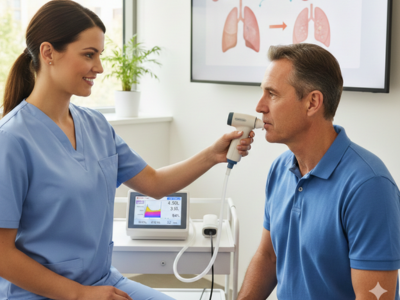
Spirometry is a pulmonary function test that evaluates lung performance. It measures the volume and speed of air you inhale and exhale. During the test, you take a deep breath and blow forcefully into a spirometer. The device records airflow data and creates measurable results. Although the process seems simple, it provides valuable clinical insight.
Spirometry focuses on two primary measurements. Forced Vital Capacity, or FVC, measures the maximum amount of air you exhale after a deep breath. Forced Expiratory Volume in one second, or FEV1, measures how much air you release in the first second. Doctors also calculate the FEV1/FVC ratio. This ratio helps them identify obstructive or restrictive lung patterns quickly.
Why Is Spirometry Critical in Respiratory Diagnosis
Spirometry detects lung problems before symptoms become severe. Many respiratory diseases develop gradually and remain unnoticed for years. However, spirometry reveals airflow limitations early. As a result, doctors can begin treatment sooner and prevent further damage.
For example, asthma and chronic obstructive pulmonary disease restrict airflow in different ways. Spirometry clearly identifies these patterns through measurable changes in FEV1 and FVC values. Therefore, physicians can differentiate conditions and tailor treatment plans accurately. Early diagnosis often improves long-term outcomes and enhances quality of life.
Healthcare professionals also use spirometry to monitor chronic diseases. They compare current results with previous tests to evaluate treatment effectiveness. If lung function declines, doctors adjust medications promptly. This proactive approach supports better disease control and reduces complications.
Routine spirometry also helps assess environmental exposure risks. Workers exposed to dust, fumes, or chemicals benefit from regular lung evaluations. Employers can identify early impairment and strengthen safety measures. Consequently, spirometry supports both individual health and workplace protection.
The global rise in asthma and COPD increases the demand for spirometry diagnostics. Portable and handheld devices now allow patients to monitor lung health at home. These devices reduce frequent hospital visits and improve convenience. This benefit becomes especially valuable in regions with limited pulmonary care access. Furthermore, early detection and regular monitoring create sustained demand for reliable spirometry solutions.
Who Should Get a Spirometry Test
Doctors recommend spirometry for individuals with persistent coughs or wheezing. Shortness of breath during daily activities also signals the need for evaluation. These symptoms often indicate underlying respiratory issues. Spirometry helps confirm or rule out serious conditions quickly.
Smokers and former smokers should schedule routine spirometry assessments. Long-term tobacco exposure significantly increases the risk of lung disease. Even without noticeable symptoms, early airflow limitation may exist. Regular testing ensures early intervention and better outcomes.
Doctors also request spirometry before certain surgeries. Strong lung function supports safer anesthesia and recovery. If results show weakness, clinicians adjust surgical plans accordingly. Therefore, spirometry enhances patient safety in multiple settings.
Preparing for a Spirometry Test
Proper preparation ensures accurate spirometry results. Patients should avoid smoking for several hours before testing. Nicotine temporarily alters airway function and affects measurements. Doctors may also advise pausing certain inhalers beforehand.
During the test, a technician places a nose clip on the patient. This step prevents air from escaping through the nostrils. The patient then inhales deeply and exhales forcefully into the mouthpiece. The technician repeats the test several times to confirm consistency.
Most people tolerate spirometry well. Some individuals feel brief dizziness after forceful exhalation. However, this sensation fades quickly. Because spirometry does not involve radiation or injections, it remains safe and low risk.
Understanding Spirometry Results
Doctors interpret spirometry results by comparing values to predicted norms. These norms depend on age, height, gender, and ethnicity. When results fall within expected ranges, lung function appears normal. Lower values indicate potential impairment.
A reduced FEV1 combined with a low FEV1/FVC ratio suggests obstructive disease. Asthma and COPD commonly produce this pattern. In contrast, a normal ratio with reduced FVC often signals restrictive disorders. Conditions such as pulmonary fibrosis limit lung expansion.
Sometimes spirometry reveals a mixed pattern. This result indicates both obstructive and restrictive characteristics. In such cases, doctors order additional testing for clarification. Nevertheless, spirometry provides the essential first step in evaluation.
The Benefits of Regular Spirometry Testing
Regular spirometry testing strengthens long-term respiratory management. Chronic lung diseases often fluctuate over time. Ongoing monitoring ensures treatments remain effective and appropriate. When doctors detect changes early, they intervene quickly.
Technological advancements have improved spirometry devices significantly. Modern systems offer portability, digital tracking, and remote data transmission. Healthcare providers can now review results outside traditional clinics. As telehealth expands, spirometry supports continuous respiratory care at home.
Spirometry also empowers patients to take control of their health. Lifestyle changes, such as smoking cessation, often improve measurable lung performance. Seeing objective progress motivates patients to maintain healthy habits. Therefore, spirometry encourages long-term behavioral change.
Final Thoughts
Spirometry remains one of the most valuable tools in respiratory medicine. It delivers precise measurements that guide diagnosis and treatment decisions. Doctors use it to detect disease early and monitor progression carefully. Patients benefit from improved safety, convenience, and clarity.
Because breathing supports every function of the body, lung health deserves attention. Spirometry provides the data needed to protect and strengthen respiratory performance. Through early detection and consistent monitoring, it improves outcomes and enhances quality of life.