
Imagine a world where you never have to touch a grimy charging cable again. You pull into your driveway, park your car, and walk inside. By morning, your battery is full. This isn't a scene from a sci-fi movie; it is the reality of Wireless EV Charging arriving in 2026. For years, the "plug-in" requirement has been a minor hurdle for some and a major barrier for others. Now, the technology is moving from secret laboratory tests to the very streets we drive on every day.
Whether you are an early adopter or a curious sceptic, the shift toward a cable-free future is gaining massive momentum. From the first public "electric roads" in Detroit to high-speed highway pilots in Indiana, the infrastructure is being laid right now. In this comprehensive guide, we will explore how Wireless EV Charging works, why it matters for your next vehicle, and what 2026 has in store for the "invisible" energy revolution.
What is Wireless EV Charging?
At its simplest, Wireless EV Charging uses magnetic fields to move electricity from the ground into your car. The technical term is "inductive power transfer." It works exactly like the small pad that charges your smartphone, just on a much larger and more powerful scale.
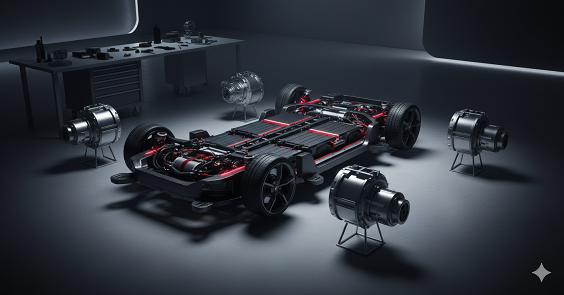
The system relies on two main components. First, there is a copper coil embedded in a ground pad (the transmitter). Second, a matching receiver pad sits on the underside of your electric vehicle. When these two pads align, they create an alternating magnetic field. This field transfers energy across an air gap, usually around 10 to 25 centimeters, and converts it back into electricity to fill your battery.
Two Ways to Charge Without Wires
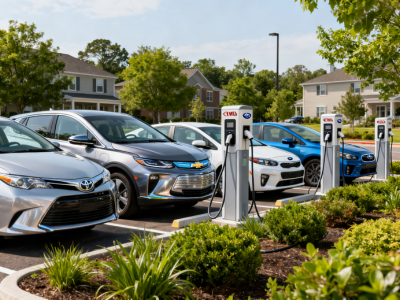
- Static Charging: This happens while your car is parked. It is perfect for home garages, grocery store parking lots, or taxi stands where vehicles sit for a while.
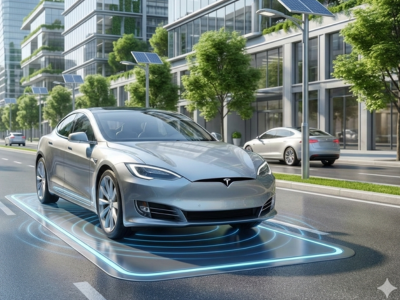
- Dynamic Charging: This is the "holy grail" of transportation. It involves embedding coils under the road surface to charge your car while it is moving. In 2026, we are seeing the first real-world highway segments designed to do exactly this.
Where is it Piloting in the U.S. Right Now?
You don’t have to look far to see Wireless EV Charging in action. Several states have become the proving grounds for this technology, moving beyond the "pilot" phase into functional public use.
The Motor City Leads the Way
Detroit recently launched the first public wireless charging road in the United States. Located near the Michigan Central innovation hub, a quarter-mile stretch of 14th Street now features underground coils. These coils can charge compatible EVs whether they are driving at city speeds or waiting at a red light. This five-year agreement with the Michigan Department of Transportation (MDOT) aims to prove that electric roads can survive real Michigan winters.
Indiana’s Heavy-Duty Highway
While Detroit focuses on city streets, Indiana is looking at the big rigs. The Indiana Department of Transportation (INDOT), alongside Purdue University, has built a testbed using "magnetizable concrete." In late 2025, they successfully demonstrated charging a heavy-duty truck at highway speeds. This project is vital because it shows how Wireless EV Charging can support the logistics industry, allowing freight trucks to travel further with smaller, lighter batteries.
The Standards Making It All Possible
For Wireless EV Charging to work everywhere, every car needs to "speak" the same language as every charging pad. This is where global standards come in. In 2026, the industry has finally coalesced around a few key rules that ensure safety and compatibility.
- SAE J2954: This is the primary standard for light-duty vehicles. It ensures that your Ford, Tesla, or Hyundai can use the same wireless pad. It currently supports power levels up to 11 kW, which is roughly equivalent to a standard Level 2 home charger.
- SAE J2954/2: This newer standard focuses on heavy-duty vehicles like buses and trucks. It targets much higher power levels, up to 500 kW, to ensure that even a massive semi-truck can get a meaningful "top-off" while driving.
- Differential Inductive Positioning System (DIPS): One of the coolest updates for 2026 is the DIPS alignment system. It allows autonomous cars to park themselves perfectly over a charging pad with centimeter-level precision, removing the need for human guidance.
Is Wireless EV Charging Safe and Efficient?
The most common question drivers ask is: "Is it safe to drive over a giant magnet?" The short answer is yes. Wireless EV Charging systems are designed with "Foreign Object Detection" (FOD). If a cat walks under the car or a child drops a metal toy on the pad, the system instantly shuts down.
Furthermore, the electromagnetic fields are tightly controlled. They meet international safety standards that are often stricter than the limits for common household appliances. In terms of efficiency, modern systems like the WiTricity Halo now reach 90% to 93% efficiency. This is nearly identical to the efficiency of a physical plug, meaning you aren't "wasting" electricity by going wireless.
6 Benefits Drivers and Cities Will See in 2026
Why are cities and automakers investing billions into Wireless EV Charging? The benefits go far beyond just "not having to plug in."
- Accessibility for All: For drivers with mobility challenges, heavy and stiff charging cables can be a major barrier. Wireless systems provide a "hands-free" experience.
- Cleaner City Streets: No cables means less street clutter and less opportunity for vandalism. This makes urban charging hubs look and feel more like standard parking.
- Smaller, Lighter Batteries: If the road can charge your car while you drive, you don't need a massive, heavy battery that lasts for 500 miles. You can use a smaller battery, making the car cheaper and more environmentally friendly.
- Weather-Proof Reliability: Snow, ice, and rain don't bother inductive pads. Since the components are sealed underground, they are protected from the elements.
- Autonomous Ready: Self-driving taxis and delivery vans can't "plug themselves in." Wireless EV Charging is the only way for a truly autonomous fleet to operate 24/7 without human help.
- Better Battery Health: Research shows that "top-up" charging, keeping the battery between 20% and 80% throughout the day, actually helps your battery last longer than deep-cycling it overnight.
Your Wireless EV Charging Questions, Answered
Can I retrofit my current EV for wireless charging?
Yes, companies like WiTricity and HEVO offer aftermarket "receiver" kits for popular models like the Tesla Model 3 and Ford Mustang Mach-E. However, most experts suggest waiting for 2026 models, as many automakers are now including wireless-ready hardware as a factory option.
Does it work in the snow?
Absolutely. The magnetic field passes through snow and ice easily. In fact, the slight heat generated by the pad can even help melt thin layers of ice, ensuring a clear connection in winter.
Will it charge as fast as a Supercharger?
Currently, most static Wireless EV Charging is equivalent to Level 2 speeds (about 11 kW). While "ultra-fast" wireless charging exists for buses, home and public parking pads are designed for "stay-and-charge" scenarios rather than 15-minute highway stops.
How much does it cost?
In 2026, a home wireless setup costs slightly more than a high-end wired wallbox. However, as production scales, the "invisible" nature of the tech is expected to lower maintenance costs, making the total cost of ownership very competitive.
The Bottom Line: A Plug-Free Future
The transition to Wireless EV Charging marks a turning point in the history of transportation. We are moving away from the "gas station" mindset where we must stop to refuel. Instead, we are entering an era where charging happens in the background of our lives.
As we look toward the end of 2026, the combination of SAE standards, federal NEVI funding, and successful state pilots like those in Detroit and Indiana has created a clear path forward. The road itself is becoming the charger. By removing the cord, we are removing the last great friction point of electric mobility. The future isn't just electric, it's invisible, automatic, and entirely plug-free.
Sources
- U.S. DOE Vehicle Technologies Office & National Labs: dynamic wireless charging R&D and feasibility.
- Joint Office of Energy & Transportation: programs, playbook, and progress metrics.
- FHWA NEVI press release: national corridor funding details.
- City of Detroit & MDOT: public wireless road pilot and agreement.
- Purdue & FHWA?linked research: highway?speed heavy?duty charging demonstration.
- SAE International: J2954 and J2954/2 standards.