
The latest Copilot updates from Microsoft integrate multi-model AI workflows and enhanced validation tools. These enhancements are designed to improve both the accuracy and reliability of Copilot, reinforce its function as an AI research assistant, and broaden access to Copilot Cowork, the newest agentic AI tool.
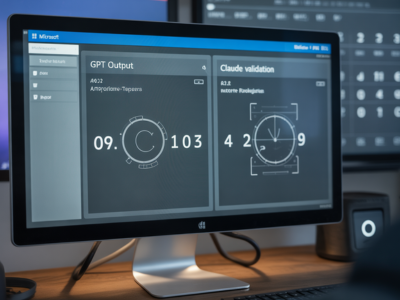
A primary update is the integration of OpenAI’s GPT and Anthropic’s Claude within Copilot’s Researcher agent, enabling both models to operate within a unified workflow. GPT generates responses, which Claude then critiques for accuracy before delivery. Microsoft intends for this review process to become reciprocal, allowing each model to evaluate the other's outputs. This collaborative framework transitions Copilot from a single-model assistant to a multi-model system in which engines cooperate to refine results.
These enhancements have significant implications for the United States market. While AI adoption among U.S. businesses is increasing, concerns regarding reliability and hallucinations persist. The new Microsoft Copilot updates address these issues by providing enterprises with more dependable AI-powered decision-making. American companies now have access to AI model collaboration tools that reduce misinformation, accelerate workflows, and enhance confidence in automated research tasks.
With the expansion of AI-driven workplace automation across industries, Copilot’s improvements may accelerate enterprise AI adoption and strengthen Microsoft’s competitive position in the U.S. productivity software sector. Enhanced accuracy and validation tools are also likely to encourage adoption among regulated sectors such as healthcare, finance, and legal services.
Microsoft has also introduced Council, a feature that presents side-by-side comparisons of responses from different AI models. This functionality provides users with greater control in selecting the most accurate or appropriate results. Council is particularly valuable for complex tasks such as research synthesis, policy reviews, and strategic planning, where quality and nuance are critical.
Nicole Herskowitz, corporate vice president for Microsoft 365 and Copilot, stated that these changes advance Copilot into a new phase of collaborative AI assistance. Rather than selecting a single preferred model, users now benefit from AI models that validate one another. She emphasized that this cooperation among models will reduce hallucinations, enhance reliability, and promote improved enterprise productivity outcomes.
In addition to these features, Microsoft has expanded access to Copilot Cowork, an agent modeled after Anthropic’s Claude Cowork platform. Copilot Cowork functions as an interactive collaborator, capable of decomposing tasks, executing multi-step reasoning processes, and autonomously managing complex projects. The tool is currently being deployed to members of Microsoft’s Frontier program, which offers early access to new AI features. Microsoft anticipates that Cowork will enable teams to automate workflows that previously required multiple manual steps.
Microsoft’s recent AI initiatives occur in the context of heightened competition from platforms such as Google Gemini and Anthropic’s autonomous agents. The company seeks to establish leadership through deeper integration of multi-model AI, advanced validation mechanisms, and agentic AI workflows capable of independent task execution.
These developments also reflect Microsoft’s broader AI innovation strategy for 2026. The company envisions Copilot evolving into a next-generation AI assistant that supports comprehensive work processes rather than merely responding to queries. By facilitating model collaboration, mutual critique, and transparent result presentation, Microsoft aims to foster greater trust and address concerns related to AI hallucinations.
Industry analysts note that Microsoft’s AI strategy could help set new standards for enterprise AI productivity tools. The combination of Critique, Council, and Cowork positions Copilot as a strong competitor in the rapidly evolving conversational AI space.
The Conversational AI market is expanding as organizations invest in tools that automate communication, streamline knowledge work, and facilitate multi-model AI integration. Vendors are prioritizing strategies that combine accuracy enhancements, agentic workflows, and cross-model collaboration to develop more reliable AI assistants. Market growth is projected to accelerate as organizations seek advanced conversational systems capable of managing complex tasks with minimal oversight.
With the latest Microsoft Copilot updates, the company makes a strong move to address reliability challenges and set the foundation for future collaborative AI systems. As competing AI assistants gain traction, Microsoft aims to stay ahead through innovation that blends accuracy, automation, and multi‑model intelligence into one unified platform.