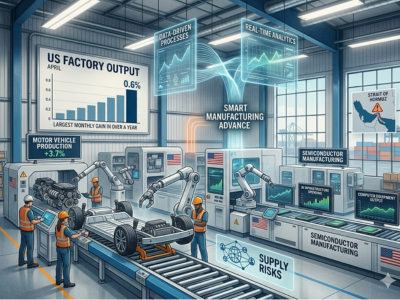

US manufacturing production showed strong growth in April, driven by rising demand for vehicles and technology products. The latest data highlights how US manufacturing production continues to benefit from heavy investment in artificial intelligence. However, global supply risks linked to m The factory production rose by 0.6% in April, its biggest month-on-month increase in well over a year. The production growth was better than forecasts and followed a mild increase in March. Experts attribute this growth to a robust demand within most industries. Hence, the manufacturing industry is more robust than anticipated at the beginning of the year.
Motor vehicle production played a major role in the increase. Output in this segment jumped 3.7 percent during the month. This rise reflects ongoing automotive manufacturing expansion, especially in electric vehicles. In addition, durable goods production climbed by 1.2 percent, signaling steady demand for long-lasting industrial products.
Technology-related industries also supported overall growth. High-technology manufacturing industries recorded a 1.0 percent increase in output. Semiconductor production growth in the USA added to this momentum. Production of computers and equipment rose steadily, while communications equipment output also improved. These gains show how AI-driven industrial demand is reshaping factory operations. Companies are also making increased investments in AI infrastructure. This drives the need for higher-quality processors and server parts. The current semiconductor boom will thus be maintained in the industry. It is expected that AI investment demand will continue to be an important factor in the coming quarters.
Amid ongoing industrial growth, smart manufacturing continues to advance. Companies are increasingly investing in automation, robotics, and data-driven processes to enhance operational efficiency. Smart factories utilize real-time analytics and interconnected systems to minimize production delays. These developments enable faster and more adaptable production cycles. As artificial intelligence becomes integral to manufacturing operations, organizations are formulating long-term modernization strategies. The United States currently holds the largest share of the global smart manufacturing market, a position that fosters sustained investment in digital tools and advanced production technologies.
Despite strong gains, supply concerns continue to loom. The ongoing conflict involving Iran has disrupted global trade routes. Shipping in the Strait of Hormuz faces ongoing risks, which affect material flows. These disruptions have already caused shortages of key inputs like aluminum and chemicals. Delivery delays are also increasing. A recent survey showed that supplier delivery times worsened significantly in May. Companies now face slower shipments and uncertain inventory levels. Consequently, US manufacturing supply shortages may impact production schedules in the coming months.
Another factor is that rising costs associated with energy also add pressure. Energy cost has gone up owing to geopolitical concerns. Rising energy costs will increase production costs for the manufacturing industry. This might affect the profitability of businesses.
While the auto and tech industry had decent results, other segments performed poorly. The output for nondurables has gone down. Also, production in chemicals, plastics, and rubber products has gone down noticeably. The food and beverages segment provided some relief. Capacity utilization in the industry increased somewhat. The aggregate capacity of the industrial sector was 76.1 percent in April. This represents an improvement in the utilization of factory capacity. Despite that, capacity utilization is still lower than historical averages.
Consequences of these trends can be seen throughout America. High production rates in US manufacturing encourage employment and growth. AI growth spurs investments into technology and infrastructure. However, continuous supply chain disruptions can hamper further production growth. The US accounts for the largest share of the global manufacturing market. This position places the country at the center of global supply chain shifts. As companies adapt to new risks, domestic production gains new importance.
Looking ahead, the outlook for US manufacturing production remains mixed. On one hand, AI investment continues to fuel demand and innovation. On the other hand, supply chain disruptions and rising costs pose real challenges. Manufacturers must navigate both forces carefully to sustain growth. Overall, recent data show that US factory output continues to expand despite uncertainty. Growth in vehicles and technology sectors highlights clear strengths. At the same time, global risks remind industries that resilience remains essential.