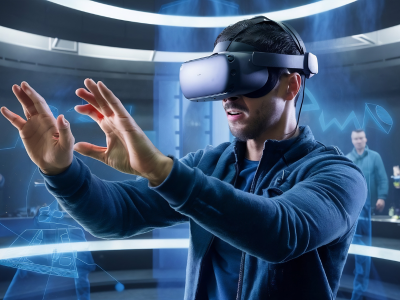

Immersive Virtual Reality is no longer an emerging idea waiting for maturity; it is becoming an essential tool for organisations seeking better performance, stronger training outcomes, and more effective collaboration. If you're wondering why every major organization is suddenly investing in headsets, simulations, and virtual workspaces, this blog is where you’ll find the answers.
In the next few minutes, you’ll discover how immersive VR is transforming real‑world training, strengthening decision‑making, reducing risks, and unlocking new ways for teams to collaborate. You’ll also learn how government agencies are already using these technologies at scale, revealing clear signals about where the future of work is heading. Most importantly, this blog breaks down what these changes mean for you, your organization, and the opportunities waiting ahead.
If you're looking for an edge in innovation, efficiency, and human performance, keep reading, because immersive VR might be the competitive advantage you’ve been waiting for.
Why Immersive Virtual Reality Matters Now
The rise of immersive experiences comes at a time when organizations need safer training environments, more efficient workflows, and tools that enhance understanding. Immersive Virtual Reality delivers exactly that.
According to federal adoption patterns, agencies use VR most often to train workers on complex procedures, support specialized tasks, and improve decision‑making. For example, thousands of personnel have received VR‑based training in areas such as emergency response, transportation security, and operational safety. The results demonstrate VR’s value in handling scenarios that are difficult, dangerous, or expensive to replicate in real life.
Enterprises can draw a clear message from this trend: Immersive Virtual Reality is not simply engaging, it is effective.
Immersive Virtual Reality as a Training Powerhouse
Training remains one of the strongest use cases for immersive tools. Traditional learning models rely heavily on lectures, written materials, and limited hands‑on practice. While these methods offer foundational knowledge, they fall short when teams must learn by doing.
Immersive Virtual Reality reverses this model
VR puts learners into realistic situations where they can safely practice skills as many times as needed. Federal agencies say that VR training helps people understand better, stay engaged, and make stronger decisions because they work with lifelike environments instead of just watching or reading.
For enterprises, this means:
- Faster onboarding
- Better retention of critical procedures
- Fewer errors during real‑world operations
- Stronger confidence among employees
Immersive Virtual Reality gives manufacturing teams a realistic way to practice equipment handling and helps sales representatives rehearse customer interactions. This kind of training feels real and leads to meaningful results.
Improving Safety and Efficiency Across Sectors
Organizations that work in high-risk environments benefit the most from immersive experiences. In government, VR is already used for emergency response, safety drills, and law enforcement training. These programs let staff practice handling stressful situations and improve their decision-making skills without real danger. Businesses can use similar methods to lower workplace risks and cut down on downtime.
For example:
- Construction teams can experience dynamic job sites before stepping onto them.
- Utility workers can rehearse hazardous repairs without risk.
- Healthcare teams can prepare for rare or complex procedures in a virtual clinic.
When employees can practice in virtual environments that mimic real‑world conditions, they perform better, respond faster, and maintain higher safety standards during live operations.
Immersive VR Enhances Collaboration and Decision‑Making
Immersive Virtual Reality is helpful for more than just training. It can also be used for planning, reviewing, and analyzing information. Many government agencies now use immersive rooms and visualization tools so teams can see data and look at complex systems from different angles. This type of spatial analysis makes information easier to understand, helps solve problems more quickly, and leads to better outcomes.
For enterprises, VR‑driven collaboration can streamline:
- Engineering design reviews
- Facility planning
- Supply‑chain simulations
- Product development cycles
Instead of reviewing documents or static images, teams can step inside a shared virtual space and interact with models in real time. This helps organizations shorten approval cycles and create stronger products with fewer revisions.
Transforming Public Engagement and Customer Experiences
One of the more surprising benefits highlighted in federal applications is the use of immersive technologies to engage the public. From virtual tours to interactive demonstrations, VR helps agencies communicate clearly and create meaningful interactions. Businesses can harness this same power to reshape their customer journeys.
Immersive Virtual Reality can:
- Show customers full‑scale product demonstrations
- Enable virtual try‑before‑you‑buy experiences
- Offer interactive walkthroughs of spaces or services
- Create captivating brand experiences at events
This creates stronger emotional connections, reduces communication gaps, and enhances customer confidence in their decisions.
Immersive Technology in Workforce Development
Across government agencies, immersive technologies support workforce training, mental health programs, and physical rehabilitation. These diverse applications reveal VR’s ability to meet multiple human-centered needs in a single, scalable format.
As workforces become more distributed and roles become more complex, enterprises can use Immersive Virtual Reality to:
- Build consistent skills across locations
- Provide structured support for stress‑related challenges
- Prepare employees for new technologies and tools
- Strengthen problem‑solving abilities
The learning advantages are clear: immersive experiences lead to deeper understanding and greater long‑term retention.
Overcoming Adoption Challenges
While immersive technologies offer immense value, government agencies also highlight challenges that enterprises must consider. These include:
- Cost of equipment and content
- Cybersecurity requirements
- Integration with existing systems
- Need for specialized development expertise
Even with these obstacles, most agencies plan to expand their use of immersive technologies through 2028, underscoring the long‑term confidence in VR’s capabilities. Enterprises can adopt a phased approach, starting with training or visualization, and expand as ROI becomes measurable.
Immersive Virtual Reality as a Strategic Growth Lever
The message is clear: Immersive Virtual Reality is no longer experimental. It is a strategic enabler that strengthens organizational resilience, improves learning outcomes, enhances customer engagement, and accelerates informed decision‑making.
Government adoption trends show that immersive technologies deliver:
- Stronger workforce capability
- Improved safety outcomes
- Enhanced operational efficiency
- Better communication across teams
For enterprises, the opportunity is to use VR to build smarter, more adaptive, and more competitive operations. Organizations that embrace Immersive Virtual Reality today position themselves ahead of the curve, not only enhancing performance but also shaping a more immersive and insightful future.