
The upcoming Amazon AI smartphone represents the company’s most ambitious effort to re-enter the mobile market since the Fire Phone’s failure over a decade ago. Amazon is developing a new device, codenamed “Transformer,” designed to integrate advanced AI features with Alexa and redefine mobile phone usage. Sources familiar with the project state that the device is central to Amazon’s renewed focus on AI-first personalization, moving away from traditional app grids. Amazon intends for the phone to serve as a daily companion, seamlessly connecting users to its services, smart home devices, and entertainment platforms.
The Amazon AI smartphone is being developed by ZeroOne, a new group within Amazon’s devices and services division, led by former Microsoft executive J Allard. While details remain confidential, insiders report the phone will emphasize AI-driven experiences and compete with current AI-powered smartphones that move beyond traditional app stores.
Amazon has considered multiple versions of the device, including a standard smartphone and a simpler “dumbphone” inspired by the minimalist Light Phone. The latter would reduce distractions and function as a companion to devices like the iPhone or Samsung Galaxy. With feature phones comprising 15% of global handset sales, this approach may appeal to consumers seeking fewer digital interruptions.
The Fire Phone’s failure continues to impact Amazon. Launched in 2014, it promised 3D visuals and shopping tools but struggled due to limited apps and battery issues. Amazon soon slashed the price and eventually discontinued the device, taking a $170 million loss. That history means the company must now offer a far more compelling reason for users to switch.
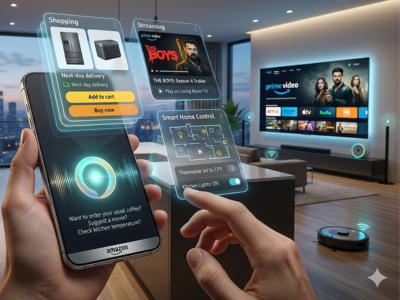
Amazon now plans to rely on AI to drive adoption. The Transformer phone could remove the need for traditional apps as autonomous AI features take over tasks directly. Shopping, streaming, maps and food delivery could operate through voice and intention-based interactions rather than manual tapping. Alexa will still play a central role, although insiders say it may not serve as the device’s core operating system.
Amazon revamped Alexa in 2025 with stronger generative AI, and the phone extends that strategy. The company wants AI to shape the entire mobile experience, turning the device into a smart assistant rather than a screen full of icons. Such an approach aligns with rising interest in app-less smartphone futures as AI agents replace traditional software navigation.
Competition remains intense. Apple, Samsung, Google, and Meta are developing next-generation smartphones with AI-first interfaces. OpenAI is collaborating with former Apple design chief Jony Ive on hardware, and numerous startups are introducing smart assistant devices that use conversational AI instead of apps. Analysts caution that Amazon has a limited window to close the gap. The smartphone market also faces pressure from rising memory chip costs and slowing global demand. Analysts expect 2026 to see one of the biggest shipment drops on record. That makes Amazon’s timing bold, especially without confirmed carrier partnerships or details on pricing.
Despite these challenges, Amazon retains key advantages. Its ecosystem integrates shopping, cloud services, streaming, and Alexa-enabled devices. Analysts note that few companies can combine so many services in a single AI-driven phone. Success could enable Amazon to build a robust mobile ecosystem supporting personalization, voice-first interactions, and seamless integration with homes and apps.
Smartphone makers are also exploring new ways to drive growth. The smartphone market continues to expand by investing in AI-led features, camera improvements and device personalization to attract new buyers. As competition intensifies, brands are adopting new strategies like AI-first operating systems and hybrid phone models to stand out.
Despite uncertainty, Amazon believes the time is right for an AI-first smartphone. The company sees mobile devices as essential gateways to consumer behavior. The Amazon AI smartphone aims to blend convenience, intelligence and personalization into a device designed for an era where AI replaces apps, and voice becomes the main interface. Amazon’s ability to succeed where it previously failed remains uncertain. However, its renewed efforts indicate that the future of smartphones will focus less on hardware and more on how effectively AI can understand and support users.