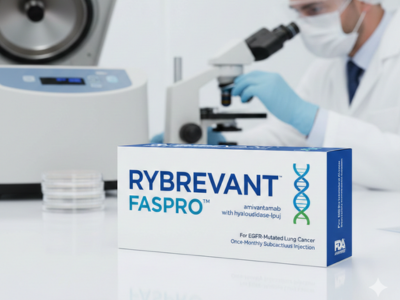

The U.S. Food and Drug Administration has approved RYBREVANT FASPRO™ for once-monthly administration in adults with EGFR-mutated advanced non-small cell lung cancer. The decision marks a significant regulatory milestone for targeted lung cancer therapy. Moreover, the approval expands convenience for eligible patients across the United States.
RYBREVANT FASPRO™ combines amivantamab with hyaluronidase-lpuj to enable subcutaneous delivery. The therapy targets epidermal growth factor receptor mutations in advanced non-small cell lung cancer. As a result, patients receive effective treatment through a shorter administration process.
Physicians prescribe RYBREVANT FASPRO™ with the oral therapy LAZCLUZE® (lazertinib) in the first-line setting. This combination addresses tumors with specific EGFR exon 19 deletions or exon 21 L858R mutations. Consequently, clinicians can offer a targeted approach at the start of treatment.
The once-monthly regimen follows earlier bi-weekly subcutaneous dosing. However, the new schedule reduces clinic visits while maintaining consistent efficacy and safety outcomes. Therefore, patients spend less time in infusion centers during ongoing care.
Earlier approvals shifted RYBREVANT FASPRO™ from intravenous infusion to a five-minute subcutaneous injection. That transition reduced administration-related reactions and shortened treatment appointments. In addition, the streamlined process improved patient comfort during therapy sessions.
Patients may transition to monthly dosing as early as week five. This flexibility allows oncologists to tailor schedules based on clinical response. As a result, care teams maintain control while reducing logistical burdens.
Medical experts emphasize the importance of convenience in long-term cancer treatment. Dr. Danny Nguyen, an Assistant Clinical Professor in medical oncology, highlighted the benefit of simplified scheduling. He noted that monthly dosing supports adherence and sustained disease management.
RYBREVANT FASPRO™ uses recombinant human hyaluronidase PH20 technology to enhance subcutaneous absorption. The ENHANZE® drug delivery platform supports consistent dispersion beneath the skin. Consequently, clinicians achieve reliable drug exposure without lengthy infusions.
Clinical evidence supports the updated dosing schedule. Data from the PALOMA-2 study demonstrated strong objective response rates with subcutaneous administration. Furthermore, safety results aligned with outcomes observed in earlier treatment schedules.
Researchers observed fewer administration-related reactions compared with historical intravenous data. These findings reinforced confidence in the subcutaneous formulation. Therefore, regulators supported the transition to monthly dosing intervals.
The safety profile of RYBREVANT FASPRO™ remains consistent with prior findings. Reported adverse events reflect EGFR and MET pathway inhibition. However, investigators did not identify new safety signals under the monthly regimen.
Clinicians also monitored venous thromboembolic events during clinical development. Event rates remained comparable to earlier dosing schedules. As a result, the overall risk profile stayed predictable and manageable.
RYBREVANT FASPRO™ holds multiple indications in EGFR-mutated non-small cell lung cancer. Physicians use it as first-line therapy in combination with LAZCLUZE®. Additionally, oncologists prescribe it with carboplatin and pemetrexed after disease progression.
The therapy also serves as monotherapy in certain advanced cases following platinum-based chemotherapy. These indications position RYBREVANT FASPRO™ across several stages of treatment. Consequently, providers can integrate the therapy throughout disease management.
Global health authorities have authorized the subcutaneous formulation in several regions. Regulators in Europe, Japan, and China have granted approvals. Therefore, international clinicians can adopt similar patient-centered dosing strategies.
EGFR-mutated non-small cell lung cancer represents a significant subset of global lung cancer diagnoses. Targeted therapies continue to reshape outcomes for these patients. In this context, RYBREVANT FASPRO™ strengthens precision oncology approaches.
The bispecific antibody targets both EGFR and MET receptors simultaneously. This dual mechanism disrupts tumor signaling pathways that drive disease progression. As a result, patients may experience improved progression-free survival.
Monthly administration aligns with broader trends in oncology care delivery. Healthcare systems increasingly prioritize efficiency and patient experience. Therefore, reduced visit frequency supports both operational capacity and individual quality of life.
Shorter appointments also ease pressure on oncology clinics managing high patient volumes. Care teams can allocate resources more effectively. Meanwhile, patients gain additional time outside clinical settings.
Support services accompany the expanded approval. The RYBREVANT withMe program assists patients with insurance verification and prior authorizations. In addition, the program provides educational resources about treatment expectations.
These services help patients navigate complex coverage processes. Consequently, eligible individuals can begin therapy without unnecessary delays. Access initiatives remain central to comprehensive cancer care.
The FDA decision reinforces continued innovation in targeted lung cancer therapy. RYBREVANT FASPRO™ now stands as the only EGFR-targeted therapy administered once monthly. Ultimately, the approval offers a streamlined, evidence-based option for adults facing EGFR-mutated advanced non-small cell lung cancer.