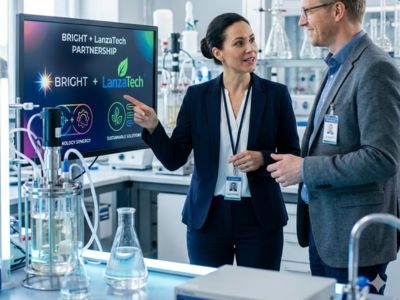

BRIGHT and LanzaTech have launched a multi-year partnership to accelerate carbon innovation across Europe. The collaboration will establish a next-generation C1 biofoundry at the Technical University of Denmark. Moreover, the project aims to transform industrial carbon emissions into sustainable fuels, chemicals, and advanced materials.
The agreement will continue until April 2028 and is mainly aimed at promoting carbon innovation via synthetic biology, automation, and gas fermentation techniques. Besides, BRIGHT will be working with LanzaTech’s biotechnological experts. This partnership aims to make Europe strong in sustainable industrial innovation. The new C1 biofoundry will operate at the Technical University of Denmark and support research into carbon conversion technologies.
Furthermore, the facility will use engineered microbes to convert carbon dioxide, methane, and carbon monoxide into valuable commercial products. Researchers believe carbon innovation can reduce industrial emissions while supporting a circular economy.
According to BRIGHT leadership, the collaboration demonstrates Denmark’s commitment to climate-focused biotechnology innovation. Christine Nellemann, provost at the Technical University of Denmark, stated that the university continues translating laboratory discoveries into industrial solutions. She added that the partnership could strengthen sustainable bio-solutions across Denmark, Europe, and international markets.
The LanzaTech team will leverage its vast experience with gas fermentation and carbon recycling technologies. Over the last 15 years, the firm has been working to develop microorganisms that can convert waste gases from industrial processes into useful compounds. Consequently, the collaboration will provide BRIGHT with advanced tools, robotic systems, and artificial intelligence-driven workflows for microbial engineering.
The partners explained that engineering specialized microbes is technologically challenging since it needs advanced anaerobic systems and an accurate setup for handling gases. Consequently, the new lab will have automated procedures, high-speed strain development, and artificial intelligence-based screening. The new system should facilitate the design-build-test-learn cycle during carbon innovation projects.
Luuk van der Wielen, director of BRIGHT, emphasized the importance of combining scientific expertise with sustainable industrial goals. He stated that the deal boosts Denmark’s goal of turning carbon emissions into valuable products. He further observed that carbon innovations can have positive impacts on both the environment and the economy of Europe.
Jennifer Holmgren, chief executive officer of LanzaTech, described the agreement as a significant milestone for the company’s transformation strategy. She elaborated that the collaboration will allow LanzaTech to bring together its biotechnology expertise while simultaneously scaling up its sustainable aviation fuel and biorefining projects. Consequently, the firm anticipates improved innovation capability and technology implementation speeds.
Under the agreement, LanzaTech will also provide BRIGHT with non-exclusive intellectual property licenses for selected biofoundry workflows and technical tools. Meanwhile, specialized teams from both organizations will jointly develop customized research methods supporting future carbon innovation programs. Industry analysts believe the shared platform could accelerate industrial adoption of low-carbon manufacturing technologies.
This partnership happens at a time when governments and industries continue to look for carbon management technologies. In Europe, more policymakers are supporting efforts to convert industrial emissions to marketable products. It follows that the BRIGHT-LanzaTech partnership can be considered a clear example of the efforts that Europe is making towards decarbonization and sustainable manufacturing development.
Industry experts consider gas fermentation an important pathway for lowering emissions from hard-to-abate industries. The technology uses microbes to capture carbon-rich gases before converting them into alternative fuels and specialty chemicals. Consequently, carbon innovation has attracted growing attention from industrial manufacturers, aviation companies, and sustainability-focused investors worldwide.
Furthermore, the organizations emphasized the need for accessibility in the study of complex biotechnology. At the moment, there are only a small number of entities that have C1 biofoundry infrastructure, which is specifically designed for gas-fermenting microorganisms. However, the Denmark-based facility intends to develop a research collaboration platform that will benefit scientists, industries, and innovation programs across Europe.
Researchers believe artificial intelligence integration will play a major role in improving microbial strain development. Large-scale screening systems can generate extensive biological data, which AI tools analyze to identify optimal microbial designs. Therefore, the partnership could significantly shorten development timelines within carbon innovation research and commercialization activities.
The BRIGHT-LanzaTech initiative marks yet another step towards investment in industrial biotechnology that can address climate change. With higher expectations in terms of reducing emissions becoming apparent, companies are still pursuing technology that could allow the conversion of waste carbon into usable resources. This alliance is meant to position Denmark and Europe as pioneers in the fast-growing field of the carbon innovation sector.