
Pune, India | October 10, 2025
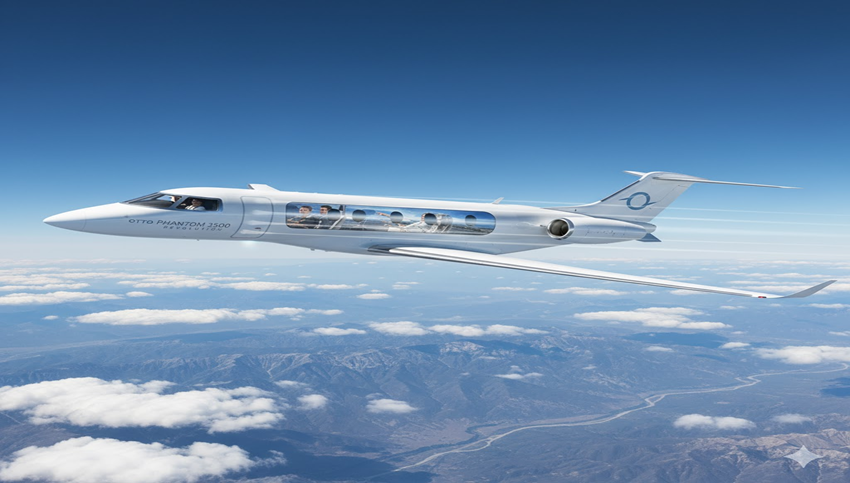
Otto Aerospace introduces the Phantom 3500, an innovative super?midsize business jet that transforms efficiency through advanced laminar flow technology. The company deliberately designed this aircraft to enhance performance using reduced structural weight, smaller engines, and exceptionally low fuel consumption.
Otto strategically targets the highly lucrative mid?market segment, which the company projects to hold an approximate value of US$25 billion worldwide. With this aircraft, Otto signals its strong intent to revolutionize business aviation through engineering precision and intelligent design philosophy.
Drawing creative inspiration from hydrodynamic torpedoes, the Phantom 3500 employs drag?reduction principles originally proven in Otto’s earlier model, the Celera 500L. Although Otto initially pursued distinctive, unconventional shapes, certification requirements under FAA regulations compelled a shift toward more practical and certifiable aerodynamic structures.
Consequently, the Phantom 3500 softens some radical design elements to meet safety standards while retaining efficiency. Bill Otto, the visionary driving the project, channels his deep expertise in hydrodynamic laminar flow to establish manufacturable innovations that balance creativity with practicality in aviation design.
The Phantom 3500’s design departs decisively from the traditional tube?and?wing layout by presenting long, slender wings and a streamlined fuselage that naturally promotes uninterrupted airflow. During high?altitude cruise operations, the aircraft achieves laminar flow across nearly 90% of its wing surfaces, enabling smoother aerodynamic performance with minimized drag. As flight conditions vary, the aerodynamic efficiency remains consistently impressive.
Consequently, Otto reports a remarkable 35% drag reduction, allowing engines that are approximately 42% smaller and lighter structures overall. Collectively, these advancements translate into a dramatic 61% decrease in both fuel burn and emissions compared to competing jets in the same performance class.
Although the Phantom 3500 embodies aerodynamic breakthroughs, Otto retains conventional components wherever certification and reliability matter most. It incorporates trusted systems, including Williams International FJ44?4 engines, Honeywell environmental controls, and Garmin avionics, ensuring dependable performance and simplified approval processes.
To enhance passenger experience without sacrificing aerodynamics, the cabin replaces traditional windows with “Supernatural Vision” technology—high?definition digital displays projecting vivid external panoramas. This innovation maintains the sleek aerodynamic profile while delivering an immersive travel ambience for occupants.
Performance forecasts for the Phantom 3500 strongly support Otto’s claims of efficiency and capability. The aircraft will transport four passengers over approximately 3,200 nautical miles while achieving a ceiling altitude near 51,000 feet. It can also operate from shorter airstrips, thanks to its refined aerodynamic geometry and balanced lift?to?drag ratio derived from the “big dumb wing” design approach.
Despite its moderate maximum take?off weight of 8,610 kilograms, it delivers performance comparable to aircraft significantly heavier, highlighting Otto’s design mastery and engineering precision.
Development continues at a methodical yet ambitious rhythm. Otto intends to complete the Preliminary Design Review (PDR) in November to finalize the external mold configuration before proceeding with the critical design phase. The prototype’s inaugural flight is scheduled for late 2027, followed by an FAA certification campaign involving four dedicated test units.
Entry into service is projected between late 2029 and early 2030. Otto has already procured all necessary long?lead components, securing approximately 75?80% of its supply chain. Key partners include Leonardo for fuselage composites and Sonaca for fabricating wing assemblies, demonstrating robust industrial collaboration for production readiness.
The manufacturing phase will operate from Otto’s new state?of?the?art facility at Cecil Airport in Jacksonville, Florida. The company plans to reach production volumes of 200 to 220 jets annually by 2035?2036. While these goals appear ambitious, Otto maintains that its factory infrastructure and supplier network are strategically optimized to support scalable growth and efficient throughput.
Market interest already affirms this confidence, as fractional jet operator Flexjet has committed to becoming the launch customer, placing firm orders for up to 300 units with additional options reserved for future expansion.
Ultimately, the Phantom 3500 could redefine expectations for aircraft within the super?midsize jet category. By merging pioneering laminar flow technology with dependable conventional systems, Otto constructs an aircraft that blends cutting?edge efficiency, minimized environmental impact, and elevated performance.
As engineering milestones progress and regulatory approval advances, Otto stands poised to establish a transformative benchmark for efficiency, comfort, and sustainability in contemporary business aviation.