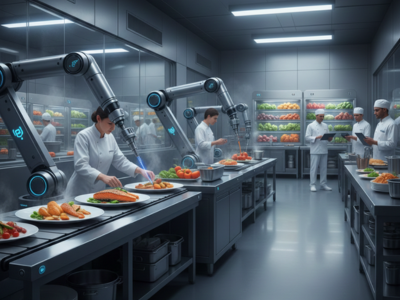

Food robotics is rapidly reshaping the global food industry by introducing automation, precision, and efficiency across every production stage. As consumer demand grows and safety regulations tighten, food manufacturers increasingly adopt food robotics to remain competitive. Moreover, these advanced technologies help organizations improve consistency, reduce operational risks, and address ongoing labor shortages. Consequently, robotics has moved from experimental adoption to a strategic necessity within food ecosystems. Therefore, understanding the role of food robotics is essential for businesses planning sustainable long-term growth.
Understanding the Concept of Food Robotics
Food robotics refers to the use of automated machines designed specifically for handling, processing, packaging, and distributing food products. These robotic systems integrate sensors, artificial intelligence, and advanced control mechanisms to perform complex tasks efficiently. Furthermore, it operates with precision that minimizes human error while ensuring hygienic handling throughout production cycles. As a result, manufacturers achieve higher output while maintaining consistent quality standards. In addition, robotics enables scalability without compromising safety or performance.
Role of Food Robotics in Food Processing
Food processing is one of the most impactful areas that delivers measurable benefits across operations. Robots handle sorting, cutting, mixing, cooking, and portioning tasks with remarkable accuracy and speed. Meanwhile, automated systems maintain uniformity, which is difficult to achieve through manual labor alone. Consequently, manufacturers reduce product variability and enhance customer satisfaction. Moreover, it significantly lowers contamination risks by limiting direct human contact with food products.
Enhancing Food Safety and Hygiene Through Robotics
Food safety remains a critical priority, and food robotics plays a vital role in meeting strict regulatory requirements. Robots operate in controlled environments and follow programmed sanitation protocols consistently. Therefore, the risk of microbial contamination decreases substantially across processing lines. Additionally, vision-enabled robots detect defects or foreign materials before products reach consumers. As a result, companies strengthen quality assurance systems while maintaining regulatory compliance. Furthermore, automated cleaning robots ensure continuous hygiene maintenance within production facilities.
Improving Productivity and Operational Efficiency
One of the strongest advantages is its ability to operate continuously without fatigue or performance decline. Unlike human labor, robotic systems function consistently across shifts and peak demand periods. Consequently, manufacturers increase production volumes without increasing workforce dependency. Moreover, it reduces downtime caused by errors or inconsistencies during repetitive tasks. Therefore, businesses achieve improved throughput while maintaining predictable operational schedules. In addition, automation supports faster response to changing market demands.
Addressing Labor Challenges with Food Robotics
Labor shortages remain a pressing issue across the food industry, particularly for repetitive and physically demanding roles. Food Robotics provides a reliable solution by automating tasks that are difficult to staff consistently. As a result, manufacturers stabilize production even during workforce fluctuations. Meanwhile, human workers transition into supervisory, analytical, and technical roles. Consequently, organizations enhance workforce efficiency while improving employee safety and job satisfaction. Furthermore, robotics reduces workplace injuries by handling hazardous or strenuous activities.
Supporting Sustainability and Waste Reduction
Sustainability has become a strategic focus, and food robotics supports environmentally responsible manufacturing practices. Robots handle ingredients with precision, minimizing spillage and material waste during processing. Additionally, automated systems optimize resource usage, including water, energy, and raw materials. As a result, manufacturers reduce their environmental footprint while improving cost efficiency. Furthermore, it contributes to better inventory management, which decreases spoilage across supply chains. Therefore, automation aligns economic goals with sustainability objectives.
Integration of AI and Smart Technologies
The integration of artificial intelligence enhances the capabilities across operations. AI-powered robots analyze real-time data and adapt to varying product types and conditions. Consequently, these systems improve decision-making and process optimization without manual intervention. Moreover, machine learning enables predictive maintenance, reducing unexpected equipment failures. As a result, manufacturers maintain consistent production flows while minimizing downtime. In addition, smart robotics supports traceability and data-driven compliance reporting.
Food Robotics in Packaging and Distribution
Packaging and distribution benefit significantly from food robotics through increased speed and accuracy. Robots handle delicate packaging tasks while ensuring uniform labeling and sealing. Meanwhile, automated guided vehicles transport products efficiently within facilities. Consequently, logistics processes become faster and more reliable. Furthermore, robotic palletizing systems reduce errors during loading and storage. Therefore, it strengthens supply chain performance while supporting faster order fulfillment.
Challenges in Adopting Food Robotics
Despite its benefits, adopting presents certain challenges for food manufacturers. High initial investment costs can discourage smaller organizations from early adoption. Additionally, companies must invest in skilled personnel to operate and maintain robotic systems. However, long-term efficiency gains often outweigh upfront expenses. Moreover, proper change management helps address workforce concerns regarding automation. Consequently, strategic planning ensures the successful integration of food robotics across operations.
Future Outlook
The future of food robotics appears promising as technologies become more adaptable and affordable. Advanced robots will increasingly handle complex, variable food products with minimal programming. Additionally, collaborative robots will work safely alongside human operators. As a result, production environments will become more flexible and responsive. Furthermore, it will play a critical role in meeting global food demand sustainably. Therefore, early adoption positions companies for long-term competitive advantage.
Conclusion
Food robotics is transforming the food industry by enhancing efficiency, safety, and sustainability across the entire value chain. Through automation, manufacturers achieve consistent quality while addressing labor and compliance challenges. Moreover, robotics supports scalable growth and environmentally responsible practices. Although adoption requires strategic investment, the long-term benefits are substantial. Consequently, food robotics stands as a cornerstone of modern food manufacturing and future industry innovation.